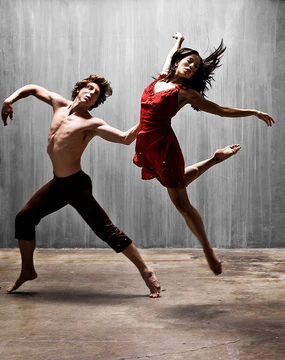
Cha-cha-cha (dance)
Cuban dance born from a rhythmic shuffle.

The cha-cha-chá (also called cha-cha) is a dance of Cuban origin, danced to cha-cha-chá music introduced by the Cuban composer and violinist Enrique Jorrín in the early 1950s. The name is an onomatopoeia derived from the shuffling sound of dancers' feet during two consecutive quick steps.
- Origin
- Cuba
- Introduced by
- Enrique Jorrín
- Introduced in
- early 1950s
- Derived from
- danzón-mambo
- First record label
- Panart
Lore & Background
In the early 1950s, Enrique Jorrín worked as a violinist and composer with the charanga group Orquesta América, performing at dance halls in Havana. Noticing dancers struggled with the syncopated rhythms of the danzón-mambo, Jorrín composed songs with a strongly marked first downbeat and less syncopated rhythm. When Orquesta América played these new compositions at the Silver Star Club, dancers improvised a triple step that produced the sound 'cha-cha-chá', giving the dance its name. Different styles of cha-cha-chá exist, with counts varying between 'one, two, three, cha-cha' (original Cuban and ballroom) and an incorrect 'street version' counting 'one, two, cha-cha-cha'. The international ballroom style involves specific footwork patterns, including a checked forward step and a chassé, danced at 30-32 bars per minute in competitions.
Reader's Guide
The cha-cha-chá dance emerged from a practical solution to a musical problem: Enrique Jorrín simplified the danzón-mambo to make it more accessible to dancers, inadvertently creating a new rhythm and dance. Its onomatopoeic name directly reflects the sound of dancers' feet, linking music and movement intimately. The dance's footwork pattern, shared with older Afro-Cuban religious dances, shows how popular culture can draw from traditional practices. The cha-cha-chá remains a staple in international ballroom competitions, where it is danced to energetic music with a steady beat, though its original Cuban style differs in timing and technique. Its legacy includes influencing later dances like salsa, which resulted from a similar timing shift of mambo.
Did You Know?
- The name 'cha-cha-chá' is an onomatopoeia from the shuffling sound of dancers' feet during two consecutive quick steps.
Birth of a Digital Icon
The Dancing Baby emerged from the intersection of commercial software development and creative experimentation in the mid-1990s. Robert Lurye, an animator at Rhythm and Hues Studios, was brought on by Unreal Pictures to produce sample animations for their prototype plug-in, which would eventually become Character Studio for Autodesk's 3ds Max application. While working with a pre-existing dancing skeleton animation, Lurye expanded the choreography, adding moves like air guitar and shoulder shakes. The baby model itself—originally a scan of a plastic doll created by Viewpoint Datalab's Tony Morrill—was paired with the skeleton's dance by team member John Chadwick using Physique software. Other contributors included Paul Bloemink, John Hutchinson, and Adam Felt.
From Discarded File to Viral Phenomenon
The Dancing Baby's journey from a forgotten demo to an internet sensation was largely accidental. LucasArts animator Ron Lussier, an Autodesk customer, recombined the original chacha.bip file with the commercially available baby model, made minor adjustments, and uploaded the result as an .avi file to a CompuServe forum. He also reportedly emailed copies to colleagues. While Girard credits Lussier with igniting the spread, Vox attributes the true viral explosion to developer John Woodell, who converted the animation into a GIF format that could be easily embedded on websites. The file proliferated across CompuServe forums, commercial and private websites, and email chains.
The Oogachacka Baby and Fan Culture
The Dancing Baby's cultural peak was fueled in large part by artist Rob Sheridan, known for his art direction work with Nine Inch Nails. Sheridan launched "The Unofficial Dancing Baby Homepage," a fan site where visitors could submit their own creative variations for him to feature. This community-driven approach transformed a simple software demo into a participatory cultural event. Sheridan's site attracted enough attention that news outlets sought him out for interviews in 1998, making him a minor internet celebrity in his own right. The fan site model demonstrated how early web communities could collectively shape and amplify a digital artifact far beyond its original creators' intentions.
Variations, Limitations, and Lasting Footprint
Despite the creative energy the Dancing Baby inspired, most user-generated modifications failed to achieve the original's cultural dominance. Animators produced a "drunk baby," a "rasta baby," a "samurai baby," and other altered versions by tweaking the sk_baby.max file's animation or modifying the character mesh itself. Yet none of these iterations matched the popularity of the virtually unchanged original. The meme's enduring appeal lay in its simplicity and the uncanny quality of a 3D-rendered toddler performing a cha-cha routine. Its legacy extends beyond mere novelty: it represented a watershed moment when a piece of commercial software demo content escaped its intended context and became a shared cultural reference point. The Dancing Baby appeared in news editorials, advertisements, and even comic programming across multiple markets, bridging the gap between niche 3D animation communities and general audiences. As one of the first viral videos, it established patterns of internet fame that would define the decades that followed.
Frequently Asked Questions
What is the cha-cha-cha dance and where did it come from?
It is a Cuban social dance that grew out of the danzón-mambo tradition in the early 1950s. The style is defined by a quick shuffling footwork pattern set to a syncopated rhythm.
Why is it called 'cha-cha-cha'?
The name is a direct onomatopoeia of the sound a dancer's shoes make against the floor during two back-to-back quick shuffle steps. It essentially mimics the rhythmic 'cha-cha-cha' noise of the footwork.
What makes the cha-cha-cha rhythm different from the mambo?
While both share Cuban roots, the cha-cha-cha rhythm layers a distinctive two-beat shuffle on top of the underlying danzón-mambo pulse, giving the dance its signature syncopated feel. That extra shuffle step is what sets the footwork—and the music—apart from the broader mambo family.
More in Dance 1-24
Spotted an error? Know more?
This is a living reference — every entry is fact-audited, and reader corrections feed straight into our audit queue. Suggest an edit · See this site's audit record