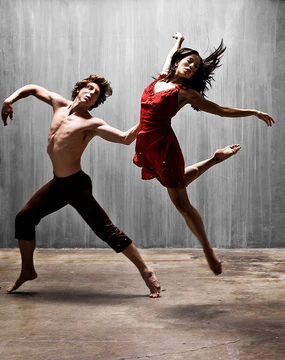
Contemporary dance
A mid-20th-century dance genre emphasizing innovation and diverse influences.

Contemporary dance is a genre of dance performance that developed during the mid-twentieth century and has since grown to become one of the dominant genres for formally trained dancers throughout the world, with particularly strong popularity in the U.S. and Europe. Although originally informed by and borrowing from classical, modern, and jazz styles, it has come to incorporate elements from many styles of dance. According to the New Grove Musical Dictionary, contemporary dance evolved from the foundations of modern and postmodern dance, emphasizing innovation and a break from traditional forms. Due to its technical similarities, it is often perceived to be closely related to modern dance, ballet, and other classical concert dance styles.
- field
- Dance performance
- known_for
- Blending ballet, modern, and cultural dance forms; emphasis on innovation and break from tradition
- key_techniques
- Contract-release, floor work, fall and recovery, improvisation, unpredictable changes in rhythm, speed, and direction
- influential_figures
- Merce Cunningham, Pina Bausch, Paul Taylor, William Forsythe, Trisha Brown
Lore & Background
Contemporary dance draws on both classical ballet and modern dance, whereas postmodern dance was a direct and opposite response to modern dance. Merce Cunningham is considered to be the first choreographer to 'develop an independent attitude towards modern dance' and defy the ideas that were established by it. Additionally, the emergence of Tanztheater, German for 'dance theater,' pushed contemporary dance beyond traditional performance boundaries. This genre incorporated everyday movements and blurred the distinction between art and daily life. Tanztheater steered contemporary dance away from linear narratives toward fragmented and montage-like choreography, giving rise to a style marked by disjointed 'dance pieces' rather than narrative styles. In the 1980s, the approach to contemporary dance became more intentional and academically focused, often described as 'interdisciplinary' and 'collaborative.' This period marked a shift from spontaneous and experimental methods to choreographies grounded in intellectual concepts, such as mathematical structures and repetitive patterns.
Reader's Guide
Contemporary dance continues to explore natural movement while embracing diverse influences and unconventional staging. It also examines the concepts of choreography and dramaturgy, collapsing the distinction between composition and improvisation, as well as between finished works and ongoing processes. This dissolution parallels broader cultural shifts from the 'linguistic turn,' which treated dance as a form of text, to the subsequent 'performative turn,' which critiques representational practices and introduces themes such as liveness, immediacy, authenticity, identity, and the interplay between presence and absence. As a result, contemporary dance works have become platforms for exploring complex themes, including the unrepresentable and intangible aspects of human existence. Post-structuralist thought has significantly influenced contemporary dance, leading to deeper exploration of the dancer’s body and the development of innovative movement techniques. Contemporary dancers train using techniques such as Graham technique, Humphrey-Weidman technique, Horton technique, Cunningham technique, contact improvisation, release technique, and non-dance practices like Pilates, yoga, and somatic practices. Choreographers like William Forsythe developed techniques that deconstructed classical dance vocabulary and expanded both the technical and conceptual possibilities of contemporary dance, integrating elements from various trends in contemporary art and thought.
Did You Know?
- Contemporary dance developed during the mid-twentieth century and has particularly strong popularity in the U.S. and Europe.
- Merce Cunningham is considered the first choreographer to develop an independent attitude towards modern dance.
- Tanztheater, German for 'dance theater,' incorporated everyday movements and blurred the distinction between art and daily life.
- Contemporary dance sometimes incorporates elements of non-western dance cultures, such as African dance bent knees or movements from Butoh.
Origins & Creative Vision
Born from the success of a Bengali-language predecessor, Dance India Dance emerged as a Hindi-language reality television series produced by Essel Vision Productions for the Zee TV network. Recognizing the format's broad appeal beyond West Bengal, Zee TV reimagined the concept for a pan-Indian audience, opening the doors to dancers from every corner of the country. The series quickly established itself as a landmark in Indian entertainment, earning multiple television awards for Most Popular Dance Reality Show. The show's structure placed a panel of choreographer-judges, affectionately called Masters, alongside a Grand Master role initially held by actor Mithun Chakraborty through season six. By rebranding a regional hit into a national phenomenon, the producers demonstrated that competitive dance television could transcend linguistic boundaries while celebrating the extraordinary diversity of Indian movement traditions.
The Gauntlet: From Open Streets to Final Eighteen
The journey from an open street audition to the main competition stage is a brutal two-phase filter. Open Auditions are staged across five or six major Indian metropolitan cities, with New Delhi, Mumbai, and Kolkata appearing in nearly every season. Dancers aged fifteen to thirty perform a brief solo routine before three Masters, who make an immediate on-the-spot decision. Those who impress receive a symbolic hat called Taqdeer Ki Topi, the Hat of Destiny, granting instant passage to the next round. The second phase, the Mega Auditions, stretches over several days and tests roughly one hundred hopefuls on stamina, well-rounded technique, and composure under pressure. Contestants face a battery of rounds requiring them to pick up diverse styles on the fly, from hip-hop and Bollywood to classical forms like Bharat Natyam, Kathak, Odissi, and Mohiniyattam. Only thirty-six survive this gauntlet, then perform solo pieces once more to narrow the field to eighteen finalists. Those eighteen are split into three teams of six, each named after its Master, and begin the weekly elimination battle for the title of India's Best Dancer.
A Mosaic of Movement: Styles & Choreography
The competition's defining feature is its refusal to confine dancers to a single genre. Across the main phase, contestants perform solo, duet, and group numbers spanning an extraordinary spectrum of styles: classical Indian forms, Contemporary, Bollywood, Hip-hop, Jazz, the martial-arts-derived Kalaripayattu, Salsa, and Musical theatre, with numerous sub-genres nested within each category. This breadth means a Kathak specialist might one week be asked to execute a Salsa combination and the next to channel the fluidity of Contemporary movement. The choreography behind these numbers is crafted by a rotating roster of Indian choreographers, including Mudassar Khan, Marzi Pestonji, Tanuj Jaggi, and Mini Pradhan, each bringing distinct technical vocabularies to the contestants' training. Success is measured not just by technical precision but by the ability to adapt, survive successive weekly eliminations, and ultimately claim a cash prize, additional awards, and the coveted title of India's Best Dancer – CJ. The show's commitment to stylistic plurality has been central to its repeated recognition as India's Most Popular Dance Reality Show.
A National Phenomenon: Adaptations & Cultural Reach
What began as a single Hindi-language series on Zee TV has since spawned a constellation of regional adaptations across the Zee network, each tailored to a specific linguistic community. Dance Maharashtra Dance appeared on Zee Marathi, Dance Karnataka Dance on Zee Kannada, Dance Kerala Dance on Zee Keralam, Dance Odisha Dance on Zee Sarthak, Dance Tamizha Dance on Zee Tamil, Dance Punjab Dance on Zee Punjabi, and Dance India Dance Telugu on Zee Telugu. This expansion mirrors the original's own journey from the Bengali-language Dance Bangla Dance to a pan-Indian platform. The Grand Salute, a ceremonial bow reserved for extraordinary performances, became a signature moment of respect between the Grand Master and contestants. By localizing the format while preserving its competitive DNA, the franchise demonstrated that the appetite for competitive dance television in India is as varied and widespread as the dance traditions it celebrates.
Frequently Asked Questions
What is contemporary dance?
Contemporary dance is a performance genre that emerged in the mid-twentieth century by weaving together elements from ballet, modern, jazz, and various cultural dance traditions. It has since become one of the most widely practiced styles among formally trained dancers, especially in the United States and Europe.
What techniques are central to contemporary dance?
Dancers in this style rely heavily on contract-release, floor work, and fall-and-recovery movements, along with spontaneous improvisation. A hallmark of the genre is its willingness to shift rhythm, speed, and direction in ways that feel unpredictable and unscripted.
Who are the key figures associated with contemporary dance?
Choreographers such as Merce Cunningham, Pina Bausch, Paul Taylor, William Forsythe, and Trisha Brown are widely credited with shaping the genre's vocabulary and pushing its boundaries. Their work helped move the form away from rigid classical structures toward greater personal expression.
How did contemporary dance evolve from earlier styles?
The genre grew out of the foundations laid by modern and postmodern dance, gradually incorporating ideas from classical ballet, jazz, and diverse cultural traditions. Its defining spirit is a deliberate break from fixed traditional form in favor of continuous innovation.
Why is contemporary dance considered important in the dance world?
It stands out for its emphasis on pushing creative boundaries and blending multiple dance traditions into a single, evolving practice. This commitment to innovation has made it one of the dominant performance genres for trained dancers worldwide.
More in Dance 1-24
Spotted an error? Know more?
This is a living reference — every entry is fact-audited, and reader corrections feed straight into our audit queue. Suggest an edit · See this site's audit record