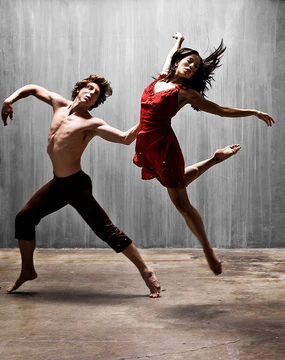
Expressionist dance
A counter-movement to classical ballet emphasizing emotion and individuality.

Expressionist dance, from German Ausdruckstanz, is a form of artistic dance in which the individual and artistic presentation (and sometimes also processing) of feelings is an essential part. It emerged as a counter-movement to classical ballet at the beginning of the 20th century in Europe, perceived as austere, mechanical and tightly held in fixed and conventional forms. Other designations include modern dance, free dance, expressionist dance, new artistic dance, and in Anglo-American countries, German dance.
- field
- Artistic dance
- known_for
- Individual and artistic presentation of feelings; counter-movement to classical ballet
- origins
- Early 20th century Europe
- related_forms
- Tanztheater, Butoh
- key_protagonists
- Isadora Duncan, Mary Wigman, Rudolf von Laban
- cultural_recognition
- Included in German List of Intangible Cultural Heritage (2014)
Lore & Background
Expressionist dance was marked by modernism, vitalism, expressionism, avant-garde, and a general protest against artistic stagnation and the old society. Ballet was perceived as superficial entertainment; the new dance would be art, both individual and artistic creation, described as the art of movement. It was a revolution, aiming to be more expressive, showing more spirit and emotion and less virtuosity, and was improvisational, uninhibited, and provocative. Future spiritual and bodily reform movements expressed themselves in a new 'natural' naked dance, with women taking centre stage.
Reader's Guide
Expressionist dance's significance lies in its revolutionary break from classical ballet, prioritizing individual expression and emotional authenticity over technical virtuosity. It emerged most prominently in Germany and the USA, countries without a deeply rooted ballet tradition, and was shaped by forerunners such as Clotilde von Derp, Hertha Feist, Hilde Holger, Loie Fuller, Jo Mihaly, and especially Mary Wigman. Wigman's school in Dresden, opened in 1920, taught premier aspiring dancers like Gret Palucca, Harald Kreutzberg, and Hanya Holm, who brought Wigman's theories to the United States. The Denishawn School in the US, founded by Ruth St. Denis and Ted Shawn, produced students such as Martha Graham and Doris Humphrey, forming the backbone of modern dance. Expressionist dance also influenced Butoh in the 1950s and continues through contemporary practitioners like Liz Aggiss and Patruni Sastry, who adapt its principles to new contexts.
Did You Know?
- Expressionist dance was included in the German List of Intangible Cultural Heritage in 2014.
- Isadora Duncan removed her dancing shoes, stating 'you do not play the piano with gloves on'.
- Butoh is inspired by German expressionist dance of the 1950s.
Frequently Asked Questions
What is Expressionist dance?
Expressionist dance, from the German term Ausdruckstanz, is an artistic dance form that places the personal, individual expression of emotion at the very center of performance. Rather than treating movement as a vehicle for story or technical display, it regards the dancer's felt experience as both the raw material and the ultimate purpose of the work.
Who are the key pioneers of Expressionist dance?
Isadora Duncan, Mary Wigman, and Rudolf von Laban are the three figures most closely associated with shaping this form in early 20th-century Europe. Their experiments in unbound, feeling-driven movement laid the groundwork for later related traditions such as Tanztheater and Butoh.
Why did Expressionist dance emerge as a movement?
It arose as a deliberate counter-movement to classical ballet, which its early practitioners saw as austere, mechanical, and locked into rigid conventional forms. Dancers wanted a style that let individual emotion and artistic intuition lead the body rather than a fixed technical vocabulary.
What other names is Expressionist dance known by?
Depending on the region and era, the same tradition has been called modern dance, free dance, new artistic dance, and—especially in Anglo-American contexts—German dance. All of these labels point to the same core idea of unbound, feeling-driven movement.
What is Expressionist dance's cultural recognition today?
In 2014 it was inscribed on Germany's List of Intangible Cultural Heritage, affirming its lasting artistic and social significance. Its influence also extends into related contemporary forms such as Tanztheater and Japan's Butoh tradition.
More in Dance 1-24
Spotted an error? Know more?
This is a living reference — every entry is fact-audited, and reader corrections feed straight into our audit queue. Suggest an edit · See this site's audit record